-TLgmZcK1heam1n69RVEGBCFlYidxUF.jpeg&w=128&q=75)
Real-time SQL subscriptions for millions of clients — and AI agents too
Most chat applications today look like this:
Postgres
↓Triggers
↓Redis / Kafka
↓WebSocket Server
↓Connected Clients
And once scale grows… things become painful:
- expensive fan-out layers
- trigger complexity
- duplicated infrastructure
- hard user isolation
- difficult GDPR cleanup
- AI agents needing separate event systems
KalamDB takes a different approach.
The Shift: SQL + Pub/Sub in One Engine
KalamDB combines:
- SQL database
- real-time subscriptions
- WebSocket fan-out
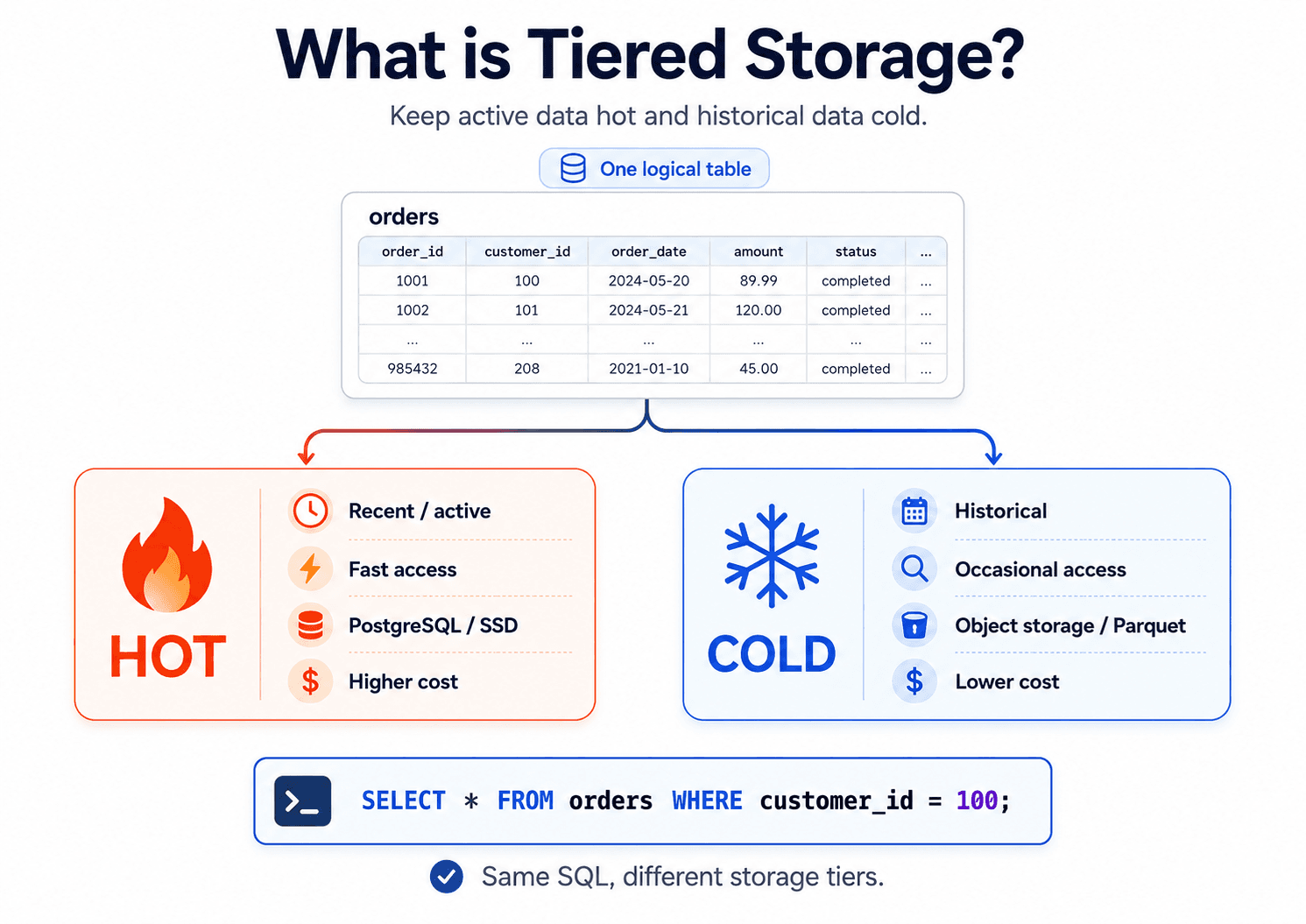
- hot/cold storage
- per-user isolation
into a single engine.
Instead of adding Redis/Kafka beside your database…
your database itself becomes the real-time engine.
Traditional PostgreSQL Fan-Out Problem
Imagine a chat app.
A user sends one message:
INSERT INTO chat.messages (...)
Now the backend must:
- store the message
- publish event to Redis/Kafka
- find subscribed users
- push over WebSocket
- notify AI agents
- update unread counters
- sync mobile/web clients
That fan-out layer becomes an entire distributed system.
KalamDB Approach
In KalamDB, subscriptions happen directly on SQL tables from the client app, Client app sends for example this query:
SUBSCRIBE TO chat.messagesWHERE conversation_id = 1OPTIONS (last_rows = 20);Then the client immediately receive inserts/updates/deletes in real time over WebSockets.
PostgreSQL → KalamDB Fan-Out Architecture
Here’s the interesting part 👇
PostgreSQL can still remain your transactional source.
But every DML event can fan out into KalamDB subscriptions.
PostgreSQL
│ INSERT / UPDATE / DELETE
│PG Kalam extension
│
▼KalamDB(Realtime SQL Engine)
│
▼
Mobile Apps Web Apps AI Agents
This gives you:
✅ PostgreSQL ecosystem
✅ Real-time subscriptions
✅ scalable WebSocket fan-out
✅ AI event streaming
✅ user isolation
Why Per-User Storage Changes Everything
Traditional databases keep all messages in one giant table:
messages---------user_idconversation_idcontent
Every subscription scans/filter the same shared table.
KalamDB instead isolates user data physically.
user1.messagesuser2.messagesuser3.messages
That means:
- subscriptions become cheap
- fan-out becomes localized
- GDPR deletion is trivial
- AI agents can subscribe per-user or globally
- noisy users don’t affect others
Targeting Specific Users Instantly 🎯
KalamDB also supports writing “as” another user
This is powerful for:
- notifications
- AI replies
- system messages
- inbox delivery
- agent-generated content
EXECUTE AS 'user-1' (INSERT INTO chat.messagesVALUES (...));This allows a backend service or AI agent to directly publish into a specific user’s isolated storage.
Real-Time Chat with AI Agents 🤖
Now things become very interesting.
An AI agent can consume all incoming messages from all users — including typing events and user presence updates:
Or even consume events from specific shards/storage groups in the future architecture roadmap.
The AI agent now behaves like a live participant inside the system:
User sends message
↓KalamDB publishes event into topic
↓AI agent consumes event instantly
↓AI generates response
↓AI inserts message back into user stream
↓Clients receive live update
Stream Tables for Typing / Presence / AI Thinking ⚡
KalamDB also supports ephemeral STREAM tables.
Perfect for:
- typing indicators
- online presence
- AI “thinking…”
- temporary events
- cancel/retry signals
CREATE TABLE chat.typing_events ( id BIGINT PRIMARY KEY DEFAULT SNOWFLAKE_ID(), conversation_id BIGINT, user_id TEXT, event_type TEXT, created_at TIMESTAMP DEFAULT NOW()) WITH ( TYPE = 'STREAM', TTL_SECONDS = 30);Subscribe:
SUBSCRIBE TO chat.typing_eventsWHERE conversation_id = 1;Now every client receives live typing updates instantly even if the user have number of clients connected with the same authentication they all will be updated in real-time.
TypeScript & React Realtime Example ⚡
KalamDB already ships with a TypeScript SDK that supports realtime live queries over a shared WebSocket connection.
import { createClient } from '@kalamdb/client'; const client = createClient({ url: 'http://localhost:8080',}); const unsubscribe = await client.live( ` SELECT * FROM chat.messages WHERE conversation_id = 1 ORDER BY created_at ASC `, (rows) => { console.log('Live rows:', rows); });And here is an example using react component:
const client = getExampleClient(); export function InboxPane({ conversationId }: { conversationId: string }) { return ( <KalamProvider client={client}> <LiveQueries queries={{ conversations: { table: conversations, orderBy: (table) => desc(table.updatedAt), limit: 20, }, messages: { table: messages, where: (table) => eq(table.conversationId, conversationId), orderBy: (table) => asc(table.createdAt), deps: [conversationId], }, }} deps={[conversationId]} > {({ conversations, messages, state }) => ( <ChatLayout conversations={conversations.rows} messages={messages.rows} busy={state.loading} /> )} </LiveQueries> </KalamProvider> );}Just SQL + live rows.
Why This Matters for AI Applications 🤖
AI systems are fundamentally event-driven.
Agents need:
- live user messages
- realtime typing/thinking states
- memory updates
- tool outputs
- notifications
- collaborative events
- streaming context
KalamDB simplifies this into:
SQL + Live Queries + Topics + Consumers
That dramatically changes how realtime systems are built.
AI Agents as Live Participants
An AI agent can consume events directly from a topic:
CONSUME FROM chat.messages;
Or only consume events for a specific user:
CONSUME FROM chat.messages
WHERE user_id = 'user_123';
The AI becomes another realtime participant in the system:
User sends message
↓KalamDB publishes event
↓AI agent consumes instantly
↓AI generates response
↓AI inserts response into chat.messages
↓Frontend receives live update immediately
One data plane.
One subscription engine.
One SQL layer.
Example End-to-End Flow 🌍
- User sends message
- PostgreSQL transaction commits
- PG Kalam extension
- KalamDB fans out changes instantly
- Mobile/Web clients receive live updates
- AI agents consume the same event stream
- AI responds with SQL INSERT
- KalamDB publishes the response live to all connected clients
No duplicated infrastructure.
No polling loops.
No custom fan-out layer.
The Bigger Vision
I believe future applications will expose live user-scoped data directly to AI agents.
Not through dozens of APIs and fragile tool chains.
But through:
SELECT ...CONSUME FROM ...INSERT ...
The same SQL backend becomes shared between:
- web apps
- mobile apps
- backend services
- AI agents
- workflows
- realtime consumers
That’s where KalamDB is heading.